
I’m preparing for procurement
I need to define what information to request, how it should be delivered, and what must be verifiable.
02 — Manage · Project Delivery + Information Management
We define how information should be requested, produced, and reviewed, connecting what the project requires with the decisions it needs to make.
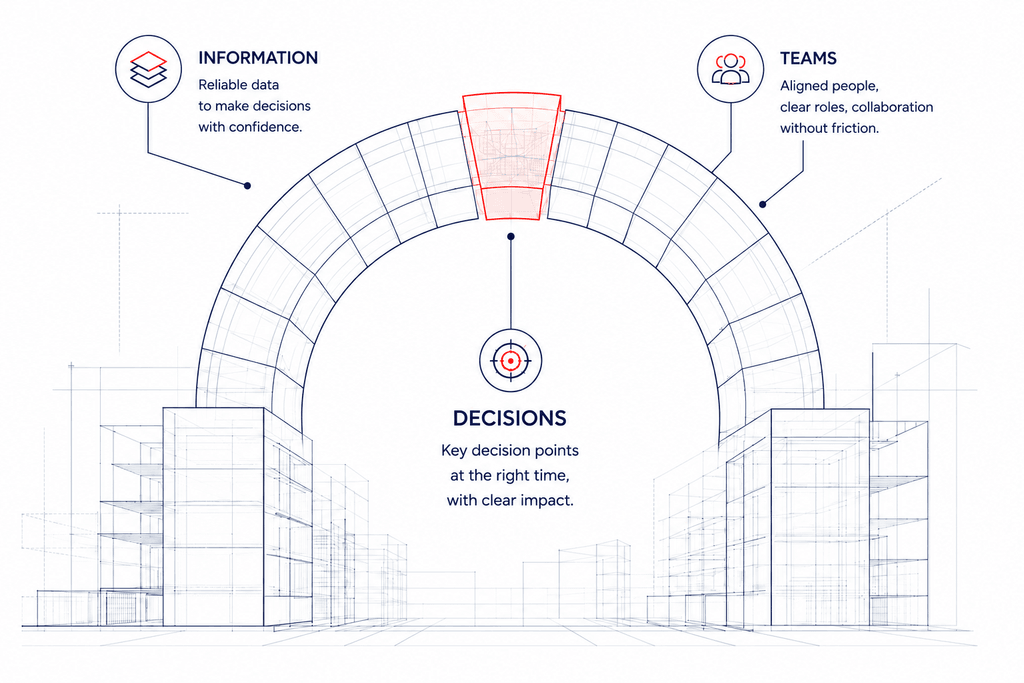
Not every project needs to organize its information at the same point. Some start before procurement. Others start once several teams are already producing, reviewing, and delivering information.
I need to define what information to request, how it should be delivered, and what must be verifiable.

I need to organize responsibilities, deliverables, and reviews across multiple organizations.

I need to identify what is current, what is missing, and what must be checked before reviewing or deciding.

Information has to carry through design, construction, handover, or operations without losing context or traceability.
Wherever you come in, we connect the missing steps.
ARCO designs the information management architecture that connects requirements, responsibilities, production, exchange, and review throughout the project.
Managing information is not just organizing documents or configuring a platform. It means defining what information the project needs, who should produce it, how it should flow and be reviewed, and what it needs to be available for.
What information does the project need, and why?
Who should create it, and under what requirements?
What must be checked before it is used?
Which review, approval, or decision must it be ready for?

Define what information should be required, how it should be delivered, and what criteria will be used to review it.
Organize responsibilities, exchanges, reviews, and deliverables across the teams producing information.
Connect the information produced with coordination, tracking, review, and decisions during construction.
Prepare the information that must be retained, verified, and transferred at closeout.
Maintain continuity of the information that those receiving and operating the asset will rely on.
Wherever you come in, we connect the missing steps.
Not every project needs to start from scratch or change its entire way of working. We can step in on a specific need and connect the necessary steps from there.
We define information requirements, responsibilities, processes, review criteria, and the structure the project needs to produce and receive useful information.
An information management architecture defined around the project’s needs.
We turn that architecture into workable processes: workflows, statuses, exchange rules, information structure, and configuration for the project environment.
Requirements and processes turned into a way of working that teams can use.
We support its application, deliverable reviews, and requirements verification to maintain continuity between what was requested, received, reviewed, and recorded.
Information that can be tracked during execution and used for the purpose it was required for.

From contract requirements to BIM implementation during construction.
The work ranged from assessing and defining BIM requirements to training teams, overseeing deliverables, and applying BIM during construction.

From contract requirements to an operational information management architecture.
The work brings together BIM requirements, deliverable oversight, strategic assessment, workshops, and the architecture needed to connect processes, information exchange, review, and traceability.
Before procurement or with production already underway, the principle is the same: connect what the project requires with the information it needs to use.
Methodology and technology are selected based on the project’s needs, stage, and environment.
ARCO integrates information requirements, responsibilities, production and exchange processes, review criteria, and tools into an information management architecture that fits the project.
Every tool has its place within a way of working designed for the project.
Wherever you come in, we connect the missing steps.
A way of working to focus on one need, apply a solution to a real case, and decide how to move forward based on evidence.
Answer a few questions about your project’s stage, the information that already exists, and what you need to solve.
The BIM Brief will help you spot potential information management gaps and give us the context we need to start the conversation from your project.

An initial conversation to understand the context, learn your starting point, and identify where ARCO could add value.
If you’ve completed the BIM Brief, we’ll use that information as the starting point for our conversation.
From what is required to what is produced, delivered, reviewed, used, and transferred.
Wherever you come in, we connect the missing steps.